How Many Porta Potties Do I Need? Construction & Event Sizing Guide
Simple sizing ratios and calculators for porta potty rentals on construction job sites and outdoor events. Compare OSHA Table D-1 minimums with standard 1-per-10 crew comfort sizing.
· · 7 min read
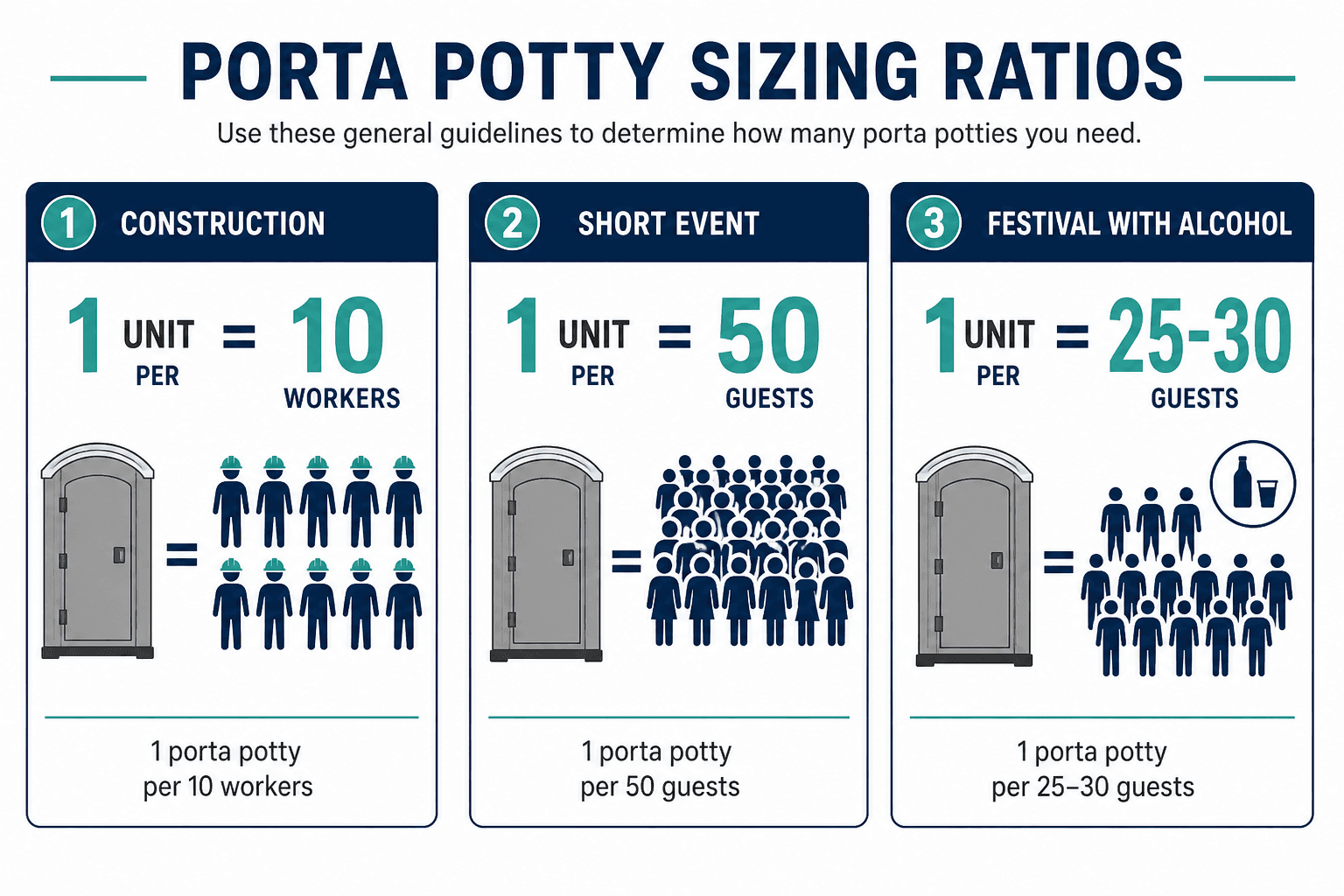
The fastest way to get a bad quote — or a messy job site — is guessing unit count. Use these starting ratios, then adjust for duration, shift structure, alcohol service, weather, and trade overlaps. This is how many porta potties you need for a job site or event in Montgomery County, Washington DC, and Prince George's County, before we look at the address.
Construction and job-site counts
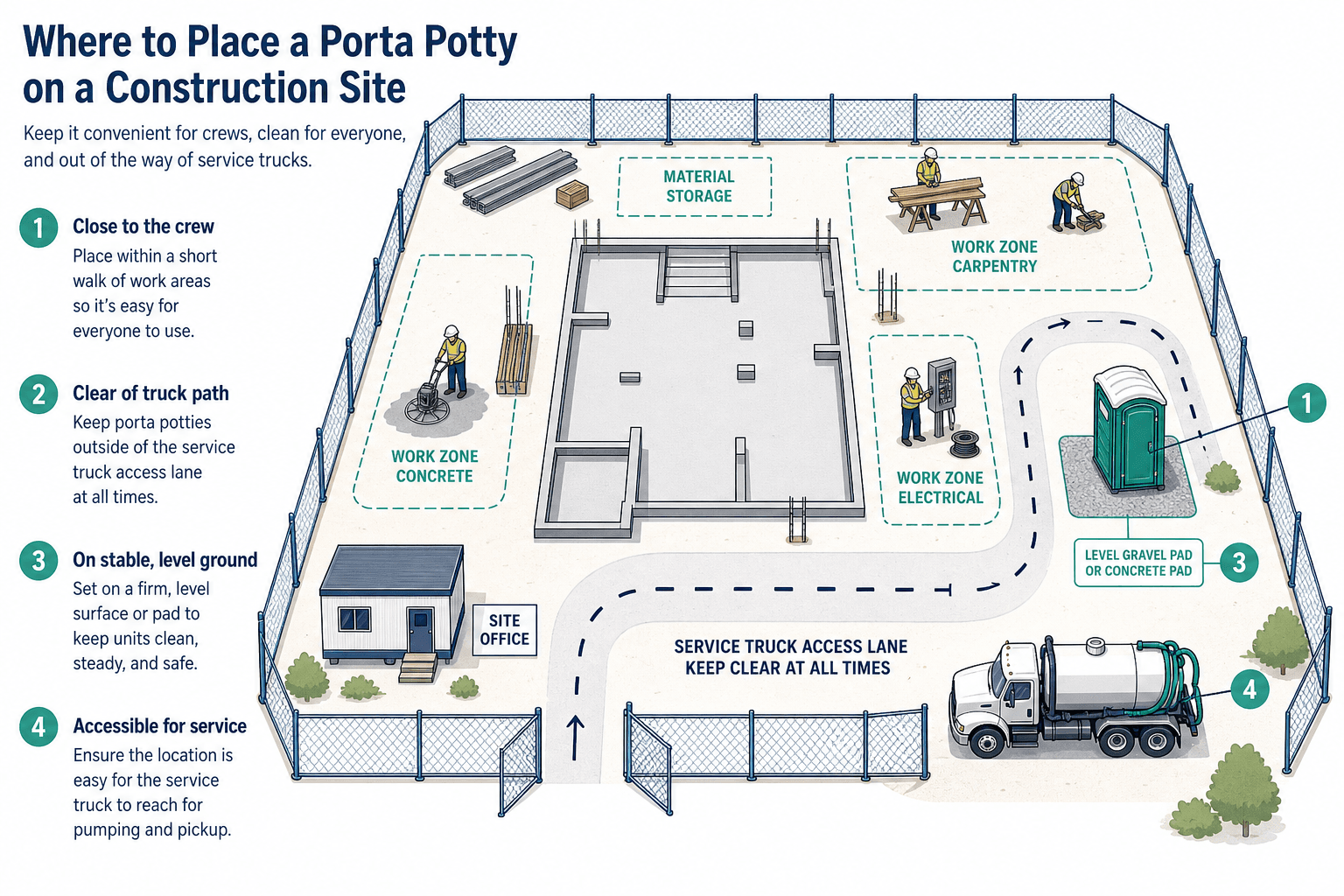
Job sites need reliable access through the full workday, not just peak hour capacity. Count the largest crew on one shift — not the weekly badge total, and not the day crew plus the night crew. Multi-building campuses often need units staged near each active work zone so people do not walk across live sites. Confirm the porta potty will fit before you count units: porta potty dimensions covers standard, deluxe, and ADA footprints.
| Workers on one shift | Industry standard (1 per 10) | Federal OSHA Table D-1 floor | Recommended weekly service |
|---|---|---|---|
| 1 to 10 | 1 unit | 1 toilet | 1x per week |
| 11 to 20 | 2 units | 1 toilet | 1x per week (or 1 unit 2x/wk) |
| 21 to 30 | 3 units | 1 seat + 1 urinal | 1x per week |
| 31 to 40 | 4 units | 1 seat + 1 urinal | 1x per week |
| 41 to 50 | 5 units | 2 seats + 1 urinal | 1x–2x per week |
OSHA Table D-1 is a legal floor, not a comfort count. Maryland and DC construction follow that table. Slide crew size on the Washington DC porta potty calculator or Maryland porta potty calculator, or read OSHA porta potty requirements. On active Montgomery County pads like Silver Spring, Bethesda, and Rockville, supers typically order 1 unit per 10 workers to keep turnover smooth.
A standard porta potty is planned for about 10 workers across one 40-hour week, then a weekly pump-out. Count the biggest crew on a single shift. Do not add the day crew and the night crew and then look them up once on the table above.
Second and third shifts
| Peak crew on one shift | 1 shift, weekly service | 2 shifts | 3 shifts |
|---|---|---|---|
| 1 to 10 | 1 unit | 2 units, or 1 pumped twice | 3 units, or 1 pumped 3x |
| 11 to 20 | 2 units | 4 units, or 2 pumped twice | 6 units, or 2 pumped 3x |
| 21 to 30 | 3 units | 6 units, or 3 pumped twice | 9 units, or 3 pumped 3x |
| 31 to 40 | 4 units | 8 units, or 4 pumped twice | 12 units, or 4 pumped 3x |
| 41 to 50 | 5 units | 10 units, or 5 pumped twice | 15 units, or 5 pumped 3x |
A second shift is another 40 hours in the same tank. Cover it with a second set of porta potties on the weekly route, or pump the first set twice that week. A third shift is a third set, or a third visit. Ten-hour days on one crew are not a second shift. That is extra use on the same toilets, so move the service day up before you add porta potties. The crew slider on this page sizes one shift. Use the table when the site runs more than one. Service days are on porta potty servicing. The legal floor is still OSHA Table D-1, which does not multiply by shift.
Job-site hand washing: Under OSHA standard 29 CFR 1926.51(f), employers must provide adequate washing facilities for employees engaged in operations where contaminants may be harmful. Standalone hand-wash stations with hands-free foot pumps and soap should be paired alongside standard units.
How many porta potties do I need for an event?
Size for the peak crowd on the ground at once, not tickets sold. A four-hour reception with an open bar is not a two-hour ceremony. Use this table, then add at least one ADA porta potty on a firm path for public or guest-facing pads.
| Guests at peak | Under 3 hours | 4–8 hours | With alcohol / food |
|---|---|---|---|
| 50 | 1 | 2 | 2 |
| 100 | 2 | 3 | 4 |
| 200 | 4 | 5 | 6–8 |
| 500 | 10 | 14 | 16–20 |
| 1,000 | 20 | 28 | 35+ |
Short outdoor mixers can run closer to one unit per 50 guests. Longer festivals with beer gardens land nearer one per 25–30 people at peak. If a line forms, you undersized or placed the pad too far from the activity.
The most common customer mistake operators see is ordering too few units. Too few means lines, overflowing tanks, and an emergency pump-out on the weekend. Operators we've learned from quote slightly above the requested count and let the customer trim it. Sizing up by one or two units is cheaper than a mid-event crisis.
Add hand-wash stations to every event order. Operators typically stock about 1 hand wash per 10 toilets. For multi-day events, ask about extra mid-event servicing to keep the pad fresh between gates.
Weddings and private events
Guest experience matters more than raw headcount. A correctly sized bank of deluxe units reduces lines and keeps the setup intentional. Place ADA units on a firm path with lighting, not tucked behind catering trucks. See wedding porta potty planning.
Festivals and public events
Peak arrival waves, beer gardens, and multi-day schedules all push ratios higher. Cluster units into pads with hand-wash stations, keep sight lines open for security, and budget overnight service for anything longer than a single afternoon. Maryland outdoor musical festivals also have a published 1-per-200 gender-designated floor.
What changes the count
- Alcohol service increases restroom demand
- Hot weather and outdoor hydration push usage up
- Kids’ events often need more frequent service than adult corporate mixers
- Long queues mean you undersized - or placed units too far from activity
- Permits and venue rules may require a minimum ADA mix
When in doubt, size up slightly or add a mid-event clean. An extra unit is cheaper than frustrated guests or an inspector who finds an underserved site. For a local quote, send the city, dates, and peak headcount - Silver Spring, Bethesda, Rockville, College Park, and the rest of Prince George's County, Washington DC, and Montgomery County use the same ratios, then adjust for truck access.
How many porta potties for this crew?
Slide peak headcount. Legal floor is the regulation. Recommended is what actually stays usable through the week.
Legal toilet floor
1
1 urinal also required
Recommended units
4
1 per 10 so weekly service stays sanitary
Recommended hand-wash
2
1 per 20 workers, on the exit path
ADA units can go on the same quote. Put the accessible unit on a firm path.
Source: OSHA Table D-1 and 1-per-10 construction sizing. Not legal advice. Count the largest simultaneous crew.
Quote 6 units including the 2 hand wash