OSHA Portable Toilet Requirements for Construction Sites
OSHA portable toilet requirements for construction: Table D-1 counts, sanitary condition, prompt access, and why a skipped pump-out can put a site out of compliance.
· 8 min read
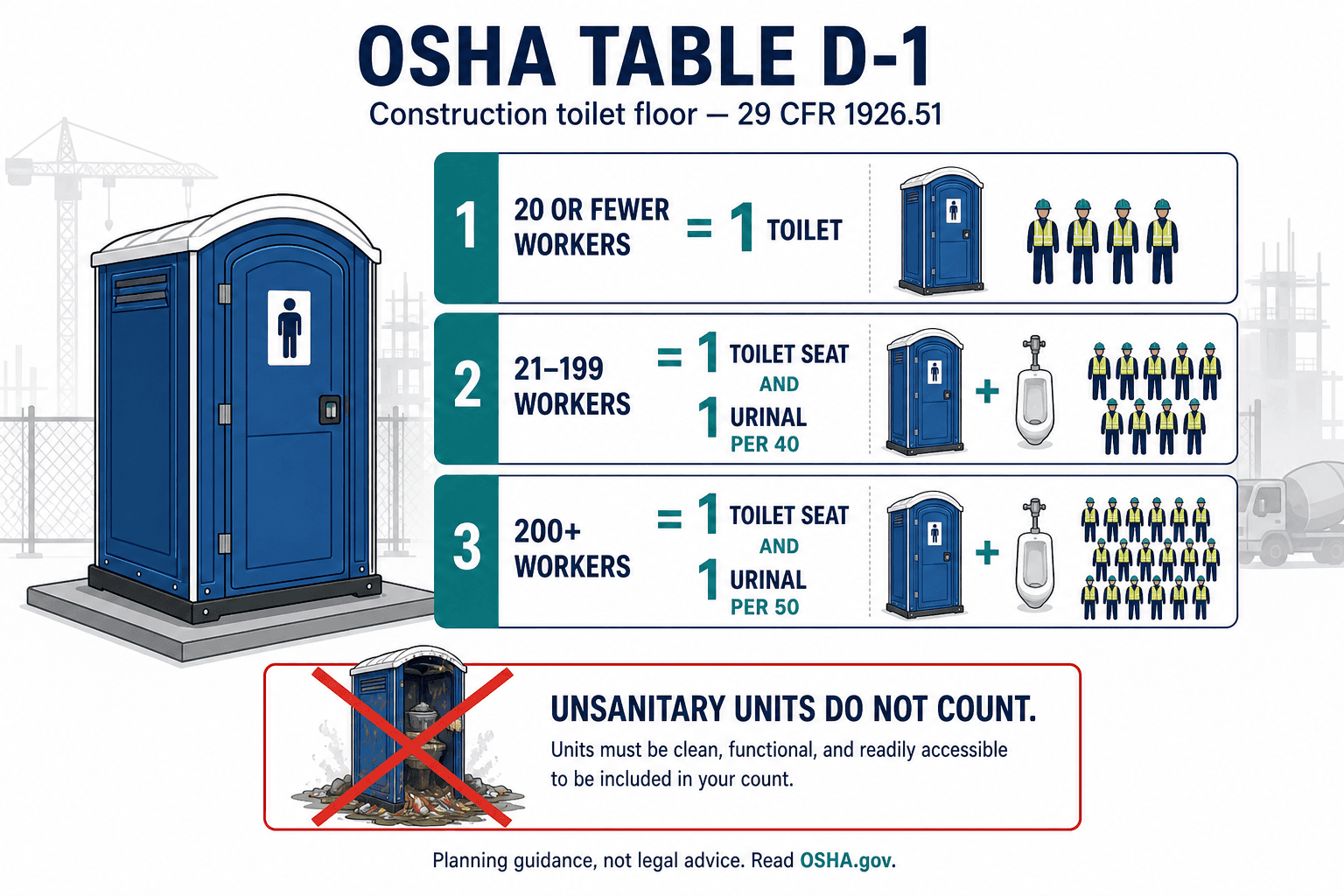
OSHA portable toilet requirements for construction are in 29 CFR 1926.51 - Sanitation, with OSHA’s overview at Restrooms and Sanitation Requirements. Employers have to give crews sanitary toilets they can actually use. That federal table applies on DC sites and, through MOSH, on Maryland sites in Prince George's County and Montgomery County. Details: Maryland and DC porta potty requirements. This is planning guidance, not legal advice.
OSHA Table D-1: the construction toilet floor
Under 1926.51(c), toilets at construction jobsites “shall be provided for employees” according to Table D-1:
| Number of employees | Minimum number of facilities |
|---|---|
| 20 or less | 1 |
| 20 or more | 1 toilet seat and 1 urinal per 40 workers |
| 200 or more | 1 toilet seat and 1 urinal per 50 workers |
That is a minimum, not a comfort spec. Count the largest crew on site at once, not the weekly badge total. Multiple shifts, overtime, and heat all push usage up even when the headcount on paper stays the same.
Why job sites still use 1 unit per 10 workers
Table D-1 allows fewer toilets than most supers will accept. OSHA’s May 17, 2006 interpretation points to ANSI Z4.3 as a servicing guide: a toilet used by up to 10 people should be emptied and cleaned at least once a week. One toilet for 20 employees should be serviced twice a week to stay sanitary.
That is the origin of the 1-per-10 construction ratio. OSHA’s count table is the floor. Weekly sanitary condition is why the industry sizes tighter. See how often porta potties should be cleaned.
A filthy unit does not count
The 2006 letter answers a question from Lanham, Maryland: do unsanitary portable toilets count toward the Table D-1 minimum? OSHA’s answer is no. A toilet that takes too long to reach is not “provided.” A toilet that is unusable because it is unsanitary is not “provided” either.
- Locked units the tech cannot enter do not count that week
- Skipped pump-outs that leave a tank unusable do not count
- A scanner-complete ticket does not make a fouled cabin sanitary
If a vendor bills a skip as a service, the employer can still be short of 1926.51. A fouled cabin with a “complete” ticket is the same failure OSHA described in 2006: the toilet was not provided.
Prompt access, not a toilet somewhere on the property
OSHA’s February 23, 2005 interpretation covers toilets only on the ground floor of a high-rise while crews work upstairs. The standard does not say “one cluster by the gate.” It says toilets must be provided - close enough that employees can use them when they need to.
- Long lines mean you undersized, even if Table D-1 is met on paper
- A 10-story stair climb can fail prompt access
- OSHA’s restroom overview describes prompt access for mobile workers as generally less than 10 minutes
- Split pads beat one distant row nobody will walk to
Chemical toilets are an allowed facility type
1926.51(c)(3) says job sites without a sanitary sewer must provide one of the listed facility types unless local codes prohibit them. Chemical toilets - the construction porta potty - are on that list, along with privies, recirculating toilets, and combustion toilets. Temporary field conditions still require at least one toilet facility.
Mobile crews with transportation ready to nearby toilets are carved out of paragraph (c). That exception is not a loophole for a 200-person pour with one locked cabin at the far fence.
Hand-washing is in the same standard
1926.51(f) covers washing facilities. Lavatories need hot and cold running water or tepid water, soap or a similar cleanser, and individual towels or a dryer. OSHA’s restroom page is blunt: “Waterless hand cleaner and towels/rags are not adequate substitutes for soap and water.”
Put the sink on the exit path of the toilet pad. A sanitizer bottle across the site is not the same plan. Pairing rules by jurisdiction: OSHA hand-wash station requirements. Equipment: hand wash station rental.
What this means on a local site
- Size to peak crew, then add for overtime, heat, and a second pad if walking time is the bottleneck
- Keep a named service weekday and a combo on file so the unit stays sanitary enough to count
- Pair ADA and hand-wash with the same pad - inspectors walk what crews use
- Treat a missed pump-out as a compliance miss, not a routing inconvenience
OSHA Table D-1 calculator
Slide peak headcount. Legal floor is the regulation. Recommended is what actually stays usable through the week.
Legal toilet floor
1
1 urinal also required
Recommended units
4
1 per 10 so weekly service stays sanitary
Recommended hand-wash
2
1 per 20 workers, on the exit path
We do not rent ADA units yet.
Source: 29 CFR 1926.51 on OSHA.gov. Not legal advice. Count the largest simultaneous crew.
Quote 4 unitsFAQ
What are OSHA portable toilet requirements for construction?
Federal OSHA construction sanitation is 29 CFR 1926.51. Table D-1 sets the toilet floor, toilets must be sanitary to count, and crews need prompt access. Maryland and DC follow that table.
How many porta potties does OSHA require per worker?
OSHA Table D-1 in 29 CFR 1926.51 is the construction floor: 1 toilet for 20 or fewer employees; 1 toilet seat and 1 urinal per 40 workers at 20 or more; 1 seat and 1 urinal per 50 workers at 200 or more. Most job sites still size closer to 1 unit per 10 workers so weekly service stays sanitary.
Do dirty porta potties still count toward OSHA’s minimum?
No. OSHA’s May 17, 2006 interpretation says a toilet that is unsanitary is not “provided,” so it does not count toward Table D-1. A unit the crew will not use is the same as a missing unit.
Is one porta potty per 10 workers an OSHA rule?
Not in Table D-1. OSHA cites ANSI Z4.3 as a servicing guide: a toilet used by up to 10 people should be serviced at least weekly. That is why 1-per-10 is the construction default even though the OSHA count table allows fewer units.
Does OSHA require hand-wash stations with porta potties?
1926.51(f) requires washing facilities and lavatories with running water, soap, and towels. Table D-1 does not list a sink count. Size hand-wash with the pad so crews actually use it.
How close do toilets need to be to the work?
OSHA requires toilets to be provided, meaning prompt access when employees need them. Letters of interpretation treat long walks and long lines as a failure to provide. For mobile crews, OSHA’s restroom overview describes prompt access as generally less than 10 minutes.
Service areas
Need a local quote?
Tell us the city, dates, and site details. We will price clean units with service included.
Request a quote