Maryland and DC Porta Potty Requirements
How construction toilet rules work in Prince George's County, Washington DC, and Montgomery County: Maryland MOSH plus COMAR chemical-toilet rules, and DC federal OSHA with DDOT public-space permits.
· 8 min read
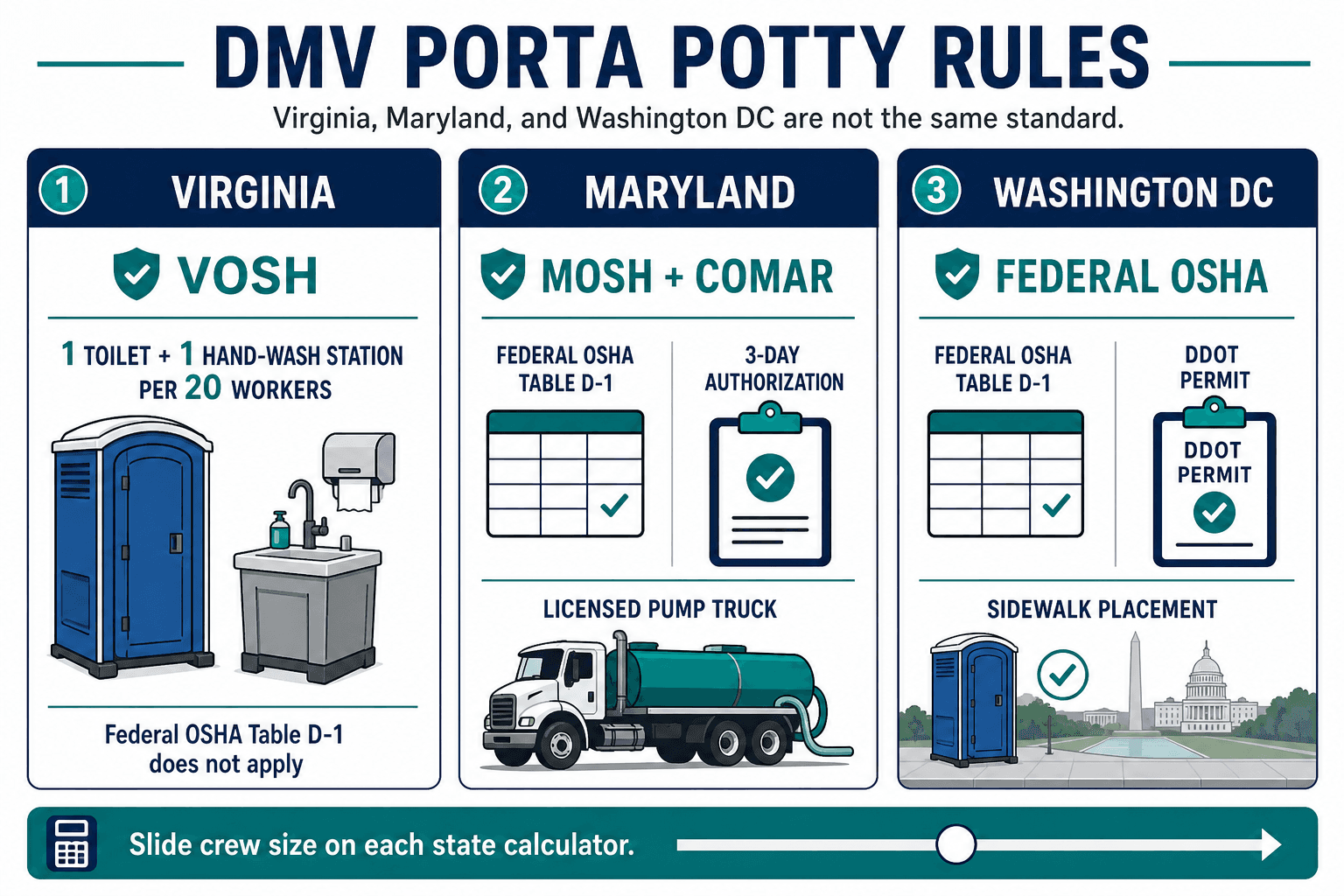
This market is two sanitation stacks, not one. Federal OSHA covers private construction in the District. Maryland MOSH adopts that federal construction standard and adds state environmental rules for chemical toilets in Prince George's County and Montgomery County. This is planning guidance, not legal advice. Read the current text on the linked .gov pages.
Quick comparison
| Jurisdiction | Who enforces toilets | Construction floor |
|---|---|---|
| Maryland calculator | MOSH + local health / MDE | Federal OSHA Table D-1, plus COMAR chemical-toilet rules |
| Washington DC calculator | Federal OSHA + DDOT / NPS for placement | Federal OSHA Table D-1; public-space permit if it sits in the ROW |
Maryland: MOSH plus COMAR chemical toilets
MOSH adopts federal OSHA construction standards (29 CFR 1926). Construction sanitation is not on Maryland’s unique-standards list, so Table D-1 is still the worker-count floor. Maryland adds a separate environmental rule for the unit itself. Slide construction or festival counts on the Maryland porta potty calculator.
COMAR 26.04.02.08 is the Maryland-specific layer. Chemical toilets still have to be impervious, vented above the roof line, and chemically charged. The current rule also says you may not keep a portable unit in place more than 3 days in a 60-day period without authorization from the Approving Authority - typically the local health department. A monthly construction stop needs that authorization, not a silent drop.
- Enforceable maintenance agreement with a qualified service company
- Pump-outs by a licensed septage hauler so the unit does not overflow or go unsanitary
- Handwashing or sanitization stations as the Approving Authority requires
- Contents removed and disposed under COMAR 26.04.02.09 - not dumped
Outdoor musical festivals are a different stack. COMAR 10.16.05.05 requires a local health permit with one designated male toilet and one designated female toilet per 200 spectators, matching hand-wash, and a daily pump-out contract if the facilities are portable.
Washington DC: federal OSHA, then placement permits
The District is not an OSHA State Plan for private employers. Federal OSHA covers DC construction sanitation from the Baltimore-Washington area office, so Table D-1 and the sanitary-condition interpretations apply. The extra DC layer is where the unit sits. Slide crew size on the DC porta potty calculator.
- Private property: GC, landlord, and building rules - not a special “porta potty permit”
- Sidewalk, curb, alley, or other public space: a DDOT public space permit through TOPS
- National Mall and NPS parkland: a National Mall special event permit; portable restrooms are a line item on the application
More on timed deliveries and pad maps: porta potty permits in Washington DC.
What to order for a local job
- Maryland and DC construction: start from Table D-1, then use 1-per-10 so weekly service holds
- Maryland festivals: use the health-permit ratio and a daily service contract, not the construction table
- DC public space or Mall: get the placement permit before the truck rolls
- Everywhere: a locked or fouled unit does not count as provided
FAQ
What porta potty rules apply on Maryland construction sites?
MOSH adopts federal OSHA construction standards, including 1926.51. Maryland also regulates portable units under COMAR 26.04.02.08: more than 3 days in a 60-day period needs Approving Authority authorization, a maintenance agreement, a licensed septage hauler, and chemical toilets that are impervious, vented, and charged. Outdoor musical festivals have separate health-permit ratios. That covers Prince George's County and Montgomery County job sites.
Do I need a permit to place a porta potty in Washington DC?
Private property is usually a GC or landlord call. Occupying sidewalk, curb, alley, or other public space requires a DDOT public space permit through TOPS. National Mall and park events go through the National Park Service.
Does Maryland or DC require a hand-wash station with the toilet?
Federal OSHA 1926.51(f) requires washing facilities with running water, soap, and towels on construction jobs. Table D-1 does not list a sink count. Pair hand-wash with the pad so crews actually use it.
Service areas
Need a local quote?
Tell us the city, dates, and site details. We will price clean units with service included.
Request a quote