What’s Inside a Porta Potty? How Tank Chemistry & Airflow Work
How a non-flushing porta potty works from Day 1 to Day 7: blue surfactant seal, passive roof-to-stack airflow, waste mounding, winter brine, and handwashing.
· · 9 min read
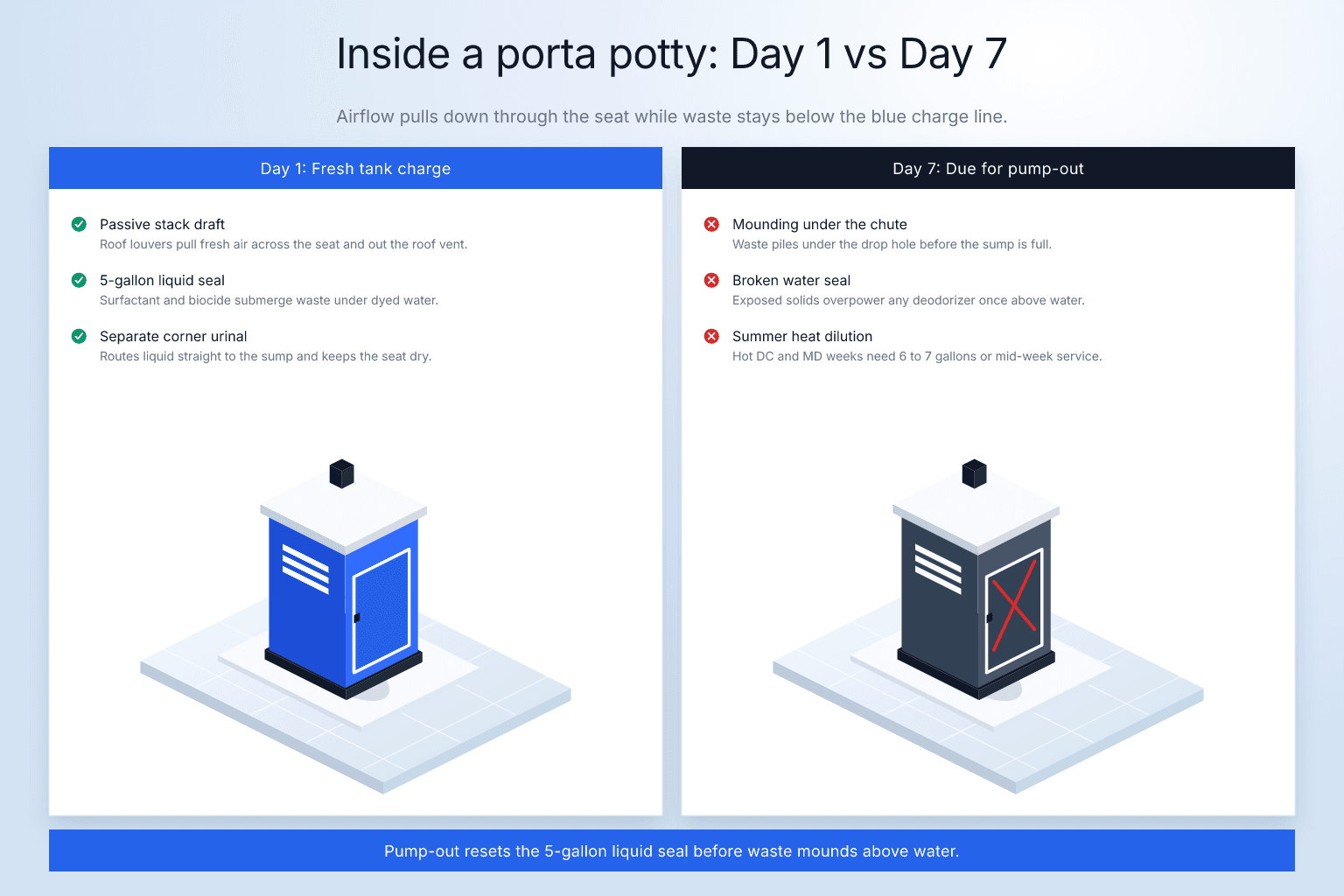
Step inside a job-site portable toilet and nothing connects to a city water main or a sanitary sewer, yet a well-run unit handles 200 uses a week without stinking out the crew. That works because three passive systems cooperate between pump-outs: a submerged liquid seal in the sump, a downward chimney draft through the seat, and separate paths for urine and handwashing. When any one of those three breaks down by Thursday, the unit fails before the tank is full. (If you need exterior measurements and pad clearances instead, use our porta potty dimensions spec sheet.)
How the non-flushing drop system works from Day 1 to Day 7
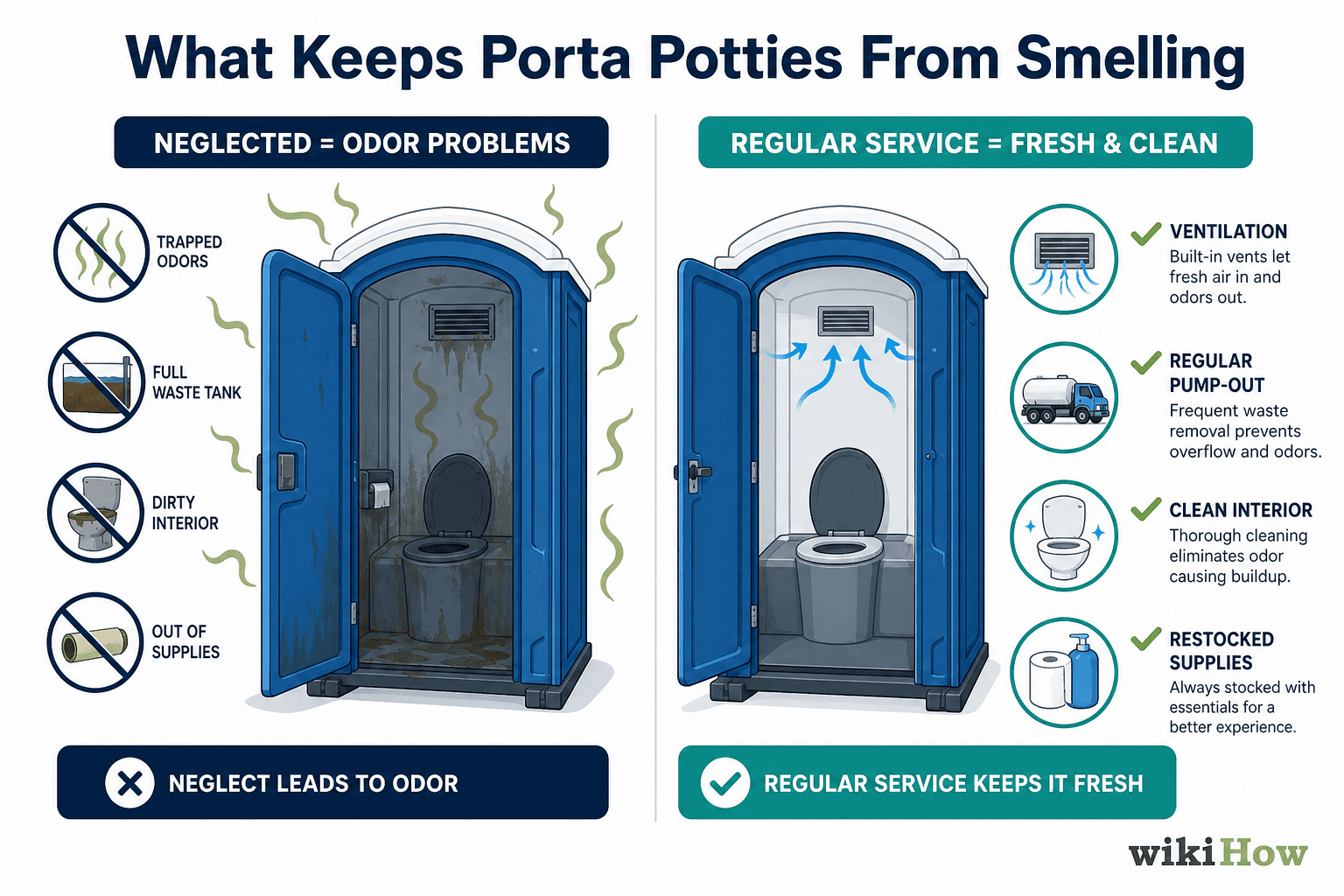
Unlike a home bathroom with a water trap in the porcelain neck, most construction units use an open gravity drop chute above a sump floor. Because there is no S-trap holding clean water in the bowl, the liquid layer at the bottom of the sump acts as the odor seal. Everything inside the cabin is built to protect that liquid seal and pull air away from the person standing inside.
| System inside the stall | Day 1 after a real pump-out | Day 7 or after a skipped stop |
|---|---|---|
| Sump liquid seal | 5 gal fresh water (6 to 7 gal in summer) submerges the drop zone | Solid cone ('mounding') pokes above the water line and vents raw odor |
| Blue surfactant & biocide | Deep royal blue tint; surfactant breaks surface film and slows bacterial gas | Turns murky green or brown as organic load consumes the active dose |
| Roof louvers & stack pipe | Cool outside air enters under the eaves, flows down the seat, exits above the roof | Spiderwebs, leaves, or overhanging tarps choke the pipe and trap warm tank air inside |
| Wall urinal & drain channel | Routes liquid down the tank wall to help keep solids submerged | Paper towels or cigarette butts clog the screen and puddle liquid |
| Paper shroud & spring latch | Dual dry rolls inside a hooded dispenser; red/green indicator snaps shut cleanly | Missing spare roll forces crews to toss shop rags into the sump, jamming the vacuum wand |
Why air is supposed to move down through the seat, not up
Look up inside a portable restroom and you will see perimeter vents molded under the translucent white roof cap, plus a black vertical pipe running straight from the top of the waste sump through the roof. Dark plastic warms the air inside that pipe faster than the shaded cabin air. As warm air rises out of the roof pipe, it creates slight negative pressure inside the sump.
When the toilet lid is down or when someone opens the door, fresh air enters through the upper roof slots, travels past the user, gets pulled down through the seat opening into the sump, and exhausts above head height. Two job-site mistakes reverse that draft immediately:
- Parking a unit directly beneath low scaffolding tarps, tree branches, or a parking-deck soffit that blocks wind across the top of the stack pipe
- Propping the spring-loaded cabin door open with a brick in July, which kills the pressure differential so sump air drifts straight into the stall
What the blue charge actually does (and why color shifts)
Operators charge a pumped sump with water plus either a water-soluble Toss-In packet or a metered squirt of liquid concentrate. Pre-measured packets dissolve slightly slower on Day 1, which gives consistent dosing across an entire route without chemical eye-burn when the first worker opens the door after service.
Four ingredients do separate jobs inside that charge: fresh water provides the physical depth that keeps waste underwater; surfactants reduce surface tension so waste sinks instead of floating; biocides or spore-based enzymes slow the anaerobic bacteria that generate ammonia and hydrogen sulfide; and royal-blue dye conceals the sump contents while acting as an honest visual gauge. When bright blue shifts to olive green mid-week, heat or heavy crew volume has exhausted the active biocide — see why porta potties smell and how to stop it.
Mounding: why tanks fail before they are full
A typical construction sump holds 60 to 70 gallons on a spec sheet, which misleads planners into thinking a crew cannot fill it in one week. Solid waste does not self-level like water. It drops onto the exact same spot beneath the seat and builds a pyramid that operators call mounding.
Once the peak of that mound rises above the 5-gallon water charge, oxygen hits unsubmerged waste and odor spikes even though two-thirds of the tank volume is still empty air. In July and August across Prince George's County, Washington DC, and Montgomery County, experienced drivers increase the initial water charge to 6 or 7 gallons to raise the waterline. On overtime or two-shift jobs, adding a second weekly pump-out is cheaper than letting crews walk past an unusable unit — compare schedules in how often porta potties should be cleaned.
Winter brine vs summer chemistry on Maryland and DC routes
From late November through March, overnight freezes turn an untreated 5-gallon water charge into a solid block of ice that a vacuum hose cannot suck out. Reputable haulers never pour hardware-store ethylene glycol or methanol windshield fluid into a tank: municipal septage receiving stations at WSSC and DC Water’s Blue Plains facility reject loads that poison biological treatment beds.
Instead, winter route trucks mix dry calcium chloride or magnesium chloride flake into the recharge water to form a plant-safe brine freeze charge. Roughly 1.5 to 2 pounds of salt per gallon protects the sump down into the teens Fahrenheit, increasing the brine weight when a hard polar snap is in the forecast.
Why the urinal is inside and the sink sits outside
Almost every standard construction cabin molds a corner urinal into the side wall with a small perforated debris screen that drains straight into the main sump. That fixture is not cosmetic: keeping standing users off the main seat cuts wipe-down mess and spreads liquid across the far side of the tank rather than soaking paper directly on top of the solid mound.
By contrast, squeezing an interior freshwater sink inside a high-traffic construction stall sacrifices elbow room for tool belts and dumps wash water into the waste sump, eating capacity fast. On commercial jobs under OSHA 1926.51(f), crews pair the toilet pad with an exterior dual-basin foot-pump hand-wash station that holds its own 20-plus gallons of clean water and a separate greywater tank.